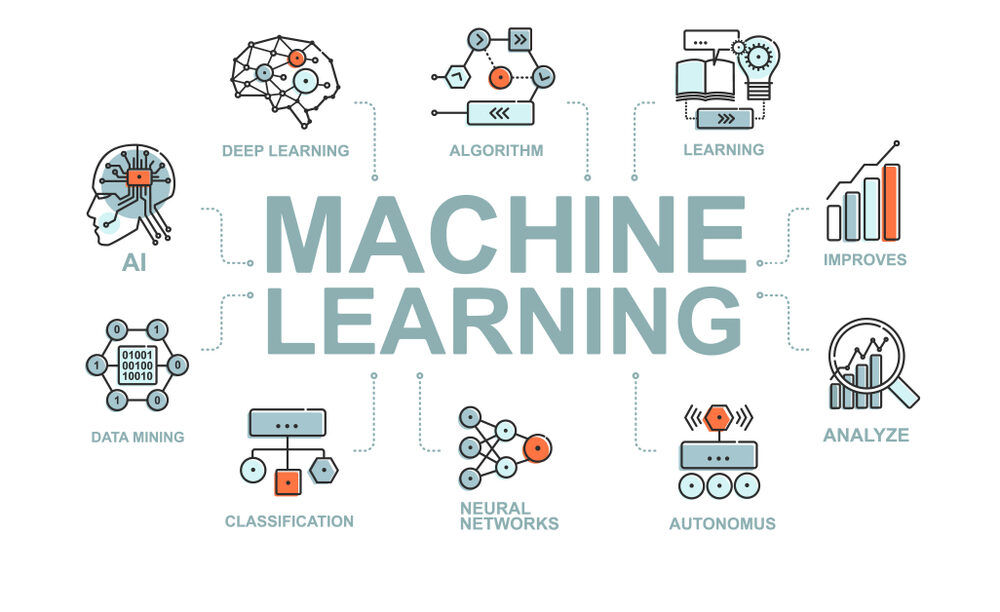
ML (Machine Learning) is a branch of AI that enables computers to learn patterns from data and make predictions or decisions without being explicitly programmed for every task.
Main Types of Machine Learning
1. Supervised Learning
The model learns from labeled data (input-output pairs).
Examples:
- Email spam detection
- House price prediction
- Disease diagnosis
Algorithms:
- Linear Regression
- Logistic Regression
- Decision Trees
- Random Forest
- Support Vector Machines (SVM)
2. Unsupervised Learning
The model finds patterns in unlabeled data.
Examples:
- Customer segmentation
- Market basket analysis
- Anomaly detection
Algorithms:
- K-Means Clustering
- Hierarchical Clustering
- PCA (Principal Component Analysis)
3. Reinforcement Learning
An agent learns by interacting with an environment and receiving rewards or penalties.
Examples:
- Game-playing AI
- Self-driving systems
- Robotics
Machine Learning Workflow


- Collect data
- Clean and preprocess data
- Select features
- Train a model
- Evaluate performance
- Deploy the model
- Monitor and improve
Popular Applications of ML
- Recommendation systems (e-commerce, streaming)
- Fraud detection
- Image recognition
- Speech recognition
- Natural Language Processing (chatbots, translation)
- Healthcare analytics
- Predictive maintenance
Popular ML Tools and Libraries
- Scikit-learn
- TensorFlow
- PyTorch
- XGBoost
- Jupyter Notebook
In One Sentence
Machine learning is the process of training computers to learn from data and improve their performance on tasks such as prediction, classification, and decision-making without explicit rule-based programming.

About the instructor
An expert in his industry, Arthur Wells is accomplished. He’s built this learning platform to help others in his industry learn and grow.